Advancing digital transformation through geoscience using Africa’s first virtual core library

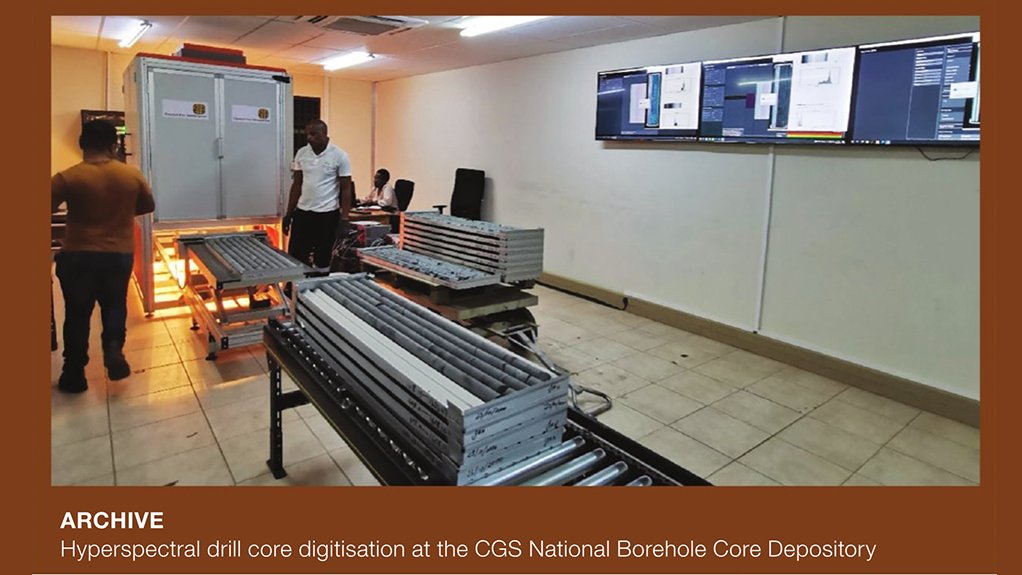
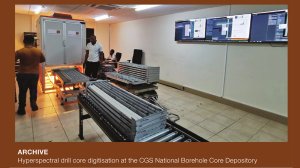
ARCHIVE Hyperspectral drill core digitisation at the CGS National Borehole Core Depository
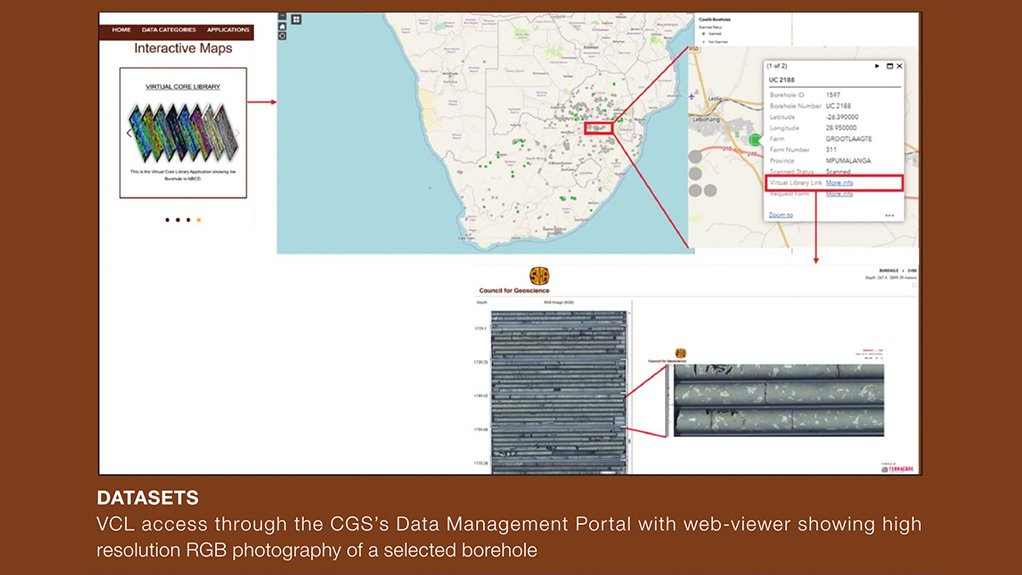
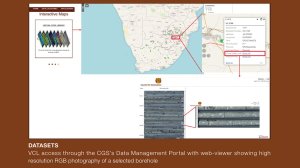
DATASETS VCL access through the CGS’s Data Management Portal with web-viewer showing high resolution RGB photography of a selected borehole
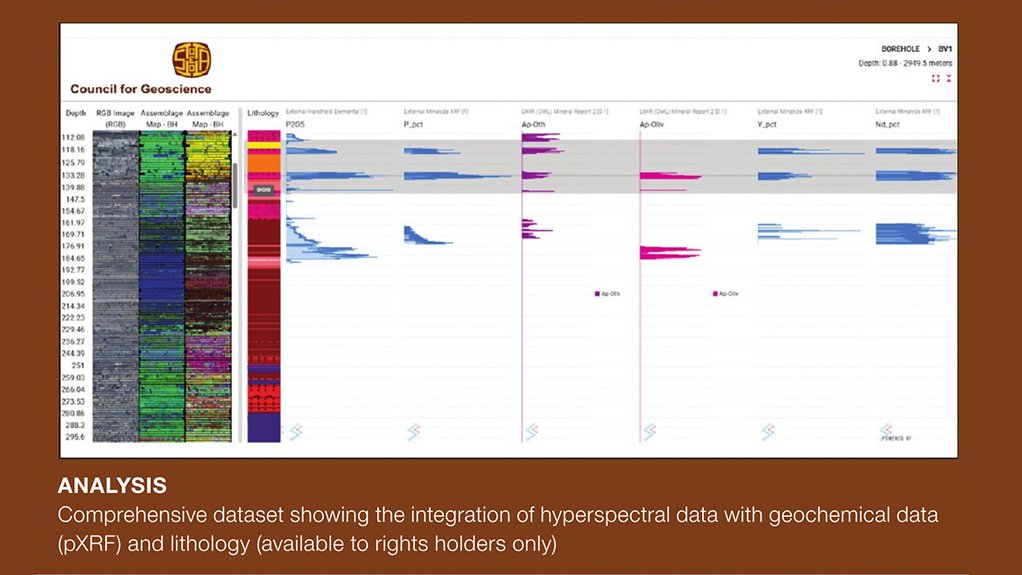
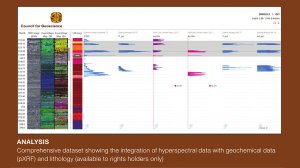
ANALYSIS Comprehensive dataset showing the integration of hyperspectral data with geochemical data (pXRF) and lithology (available to rights holders only)


National science council the Council for Geoscience (CGS) is advancing the digital transformation of South Africa’s geoscience data infrastructure through the development of Africa’s first Virtual Core Library (VCL). This initiative represents a major step towards the management, accessibility, and scientific use of the country’s national drill-core archive. By converting physical drill-core collections into high-quality, remotely accessible, digital datasets, the VCL addresses long-standing limitations associated with traditional core storage while leveraging modern analytical technologies to maximise the value of nationally significant geological material.
The National Borehole Core Depository (NBCD) houses one of the largest drill-core repositories on the African continent, containing more than one-million metres of drill core accumulated over several decades of geological exploration. These materials include borehole core, cuttings, and geochemical samples that are representative of South Africa’s major lithologies and lithostratigraphic units.
Collectively, they constitute a critical national scientific asset supporting geoscience research, mineral exploration, engineering geology, and environmental investigations. This is congruent with the statutory mandate bestowed on the CGS as the custodian of all geological data and information, both onshore and offshore, in South Africa. Despite their scientific and strategic importance, physical drill-core collections have historically been difficult to access and are underutilised as a result.
Exploration and resource evaluation programmes generate large volumes of drill core that are typically stored in physical core sheds, often located in remote areas. Access to these materials is frequently constrained by distance, logistical complexity, environmental exposure, and the high costs associated with travel, handling, and long-term storage.
Repeated physical handling also increases the risk of sample degradation, limiting the effective reuse of drill-core data for secondary research, regional synthesis, and comparative geological studies. The VCL directly addresses these challenges by creating a comprehensive digital representation of the NBCD’s curated materials.
A VCL is, by definition, a centralised digital repository that stores, manages, and presents drill-core imagery and associated datasets in an online environment. Through secure, web-based access, users can browse, search, and visually interrogate drill-core data without requiring physical access to the depository.
Central to the development of the VCL is the CGS’s application of advanced hyperspectral imaging technology. Drill cores archived at the NBCD are systematically scanned using this non-destructive and non-invasive technique, which provides highly repeatable and objective mineralogical measurements.
Hyperspectral scanning enables continuous downhole mineralogical analysis and is particularly well suited to large-scale digitisation initiatives owing to its rapid throughput, with more than 500 m of drill core capable of being scanned in a single day. The CGS has adopted a long-term programme to digitise all drill core currently archived at the NBCD, estimated at about 1 000 km, as well as future acquisitions.
To date, about 10% of the archived material has been scanned, establishing a strong foundation for the continued expansion of the Virtual Core Library. At its current stage of implementation, the VCL provides high-
resolution RGB core photography for all scanned boreholes, enabling continuous downhole visualisation, lithological assessment, identification of structural features, and preliminary geological interpretation. Access to the VCL is provided through the CGS Geoscience Data Management Portal.
Registered users can locate available boreholes using interactive web-based maps and view scanned core on desktop or smart mobile devices. This digital access enables researchers, industry stakeholders, the general public, and government users to assess borehole data prior to requesting physical samples, thereby supporting informed decision-making and more efficient use of the physical archive. In some cases, digital products derived from the VCL may fully satisfy analytical requirements, reducing the need for physical sampling and associated logistical costs. A tiered access model has been adopted to ensure appropriate data governance.
While high-resolution imagery is broadly accessible, a more comprehensive suite of datasets, including hyperspectral mineralogical products, geochemical analyses, geotechnical information, and detailed lithological logs, is made available to mineral rights holders. This approach ensures that proprietary or sensitive data are appropriately managed while the scientific and economic value of the national drill core archive is maximised.
To enhance the analytical capability of the VCL, the CGS has initiated targeted projects integrating complementary mineralogical and geochemical datasets. Borehole intervals aligned with the CGS Technical Programme have been selected for continuous, non-destructive X-ray fluorescence scanning using Minalyze’s core scanning system. These intervals were previously scanned using hyperspectral methods, enabling direct integration of mineralogical and chemical information within the VCL framework.
The resulting multi-parameter datasets support improved interpretation of lithological variation, alteration assemblages, and mineralisation patterns associated with different deposit types. Beyond improved accessibility and analytical capability, the VCL plays a critical role in the long-term preservation of South Africa’s drill-core heritage. Physical cores are inherently vulnerable to degradation through handling, environmental exposure, and time. High-quality digital records ensure that essential geological information is preserved indefinitely, safeguarding it for future generations of geoscientists, researchers, and decision-makers.
The CGS is taking a significant step towards modernising South Africa’s mineral intelligence landscape with the launch of Africa’s first VCL. This pioneering initiative, to be unveiled at the Investing in African Mining Indaba in February 2026, marks a major milestone in the digital transformation of geoscience data management and access.
By creating an easily accessible digital version of South Africa’s national drill-core collection, the VCL opens up valuable geological information to a wider range of users, including junior mining companies, emerging explorers, researchers, and ordinary South Africans looking to get into the exploration space. Instead of spending large amounts of money on new drilling programmes, users can access existing drill-core data online, quickly identify areas of interest, and make better-informed decisions at a fraction of the cost.
This faster access to reliable data helps accelerate exploration, reduces financial risk, and lowers barriers to entry for smaller players in the exploration and mining space. As the VCL continues to grow, it will play a key role in advancing digital transformation in geoscience, unlocking value from existing datasets, supporting resource development, and ensuring that South Africa’s geological knowledge benefits both the economy and society as a whole.
Article Enquiry
Email Article
Save Article
Feedback
To advertise email advertising@creamermedia.co.za or click here


Projects

Latest Multimedia

Latest News

Showroom
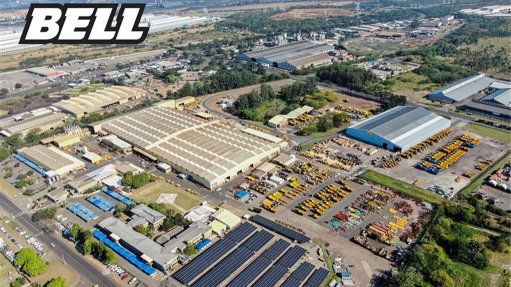
As one of South Africa's leading manufacturers, Bell Equipment distributes and exports its wide range of heavy equipment globally to mining,...
VISIT SHOWROOM



Press Office
Announcements
What's On
Subscribe to improve your user experience...
Option 1 (equivalent of R125 a month):
Receive a weekly copy of Creamer Media's Engineering News & Mining Weekly magazine
(print copy for those in South Africa and e-magazine for those outside of South Africa)
Receive daily email newsletters
Access to full search results
Access archive of magazine back copies
Access to Projects in Progress
Access to ONE Research Report of your choice in PDF format
Option 2 (equivalent of R375 a month):
All benefits from Option 1
PLUS
Access to Creamer Media's Research Channel Africa for ALL Research Reports, in PDF format, on various industrial and mining sectors
including Electricity; Water; Energy Transition; Hydrogen; Roads, Rail and Ports; Coal; Gold; Platinum; Battery Metals; etc.
Already a subscriber?
Forgotten your password?
Receive weekly copy of Creamer Media's Engineering News & Mining Weekly magazine (print copy for those in South Africa and e-magazine for those outside of South Africa)
➕
Recieve daily email newsletters
➕
Access to full search results
➕
Access archive of magazine back copies
➕
Access to Projects in Progress
➕
Access to ONE Research Report of your choice in PDF format
RESEARCH CHANNEL AFRICA
R4500 (equivalent of R375 a month)
SUBSCRIBEAll benefits from Option 1
➕
Access to Creamer Media's Research Channel Africa for ALL Research Reports on various industrial and mining sectors, in PDF format, including on:
Electricity
➕
Water
➕
Energy Transition
➕
Hydrogen
➕
Roads, Rail and Ports
➕
Coal
➕
Gold
➕
Platinum
➕
Battery Metals
➕
etc.
Receive all benefits from Option 1 or Option 2 delivered to numerous people at your company
➕
Multiple User names and Passwords for simultaneous log-ins
➕
Intranet integration access to all in your organisation